
 English
 Español
 Français
 Português
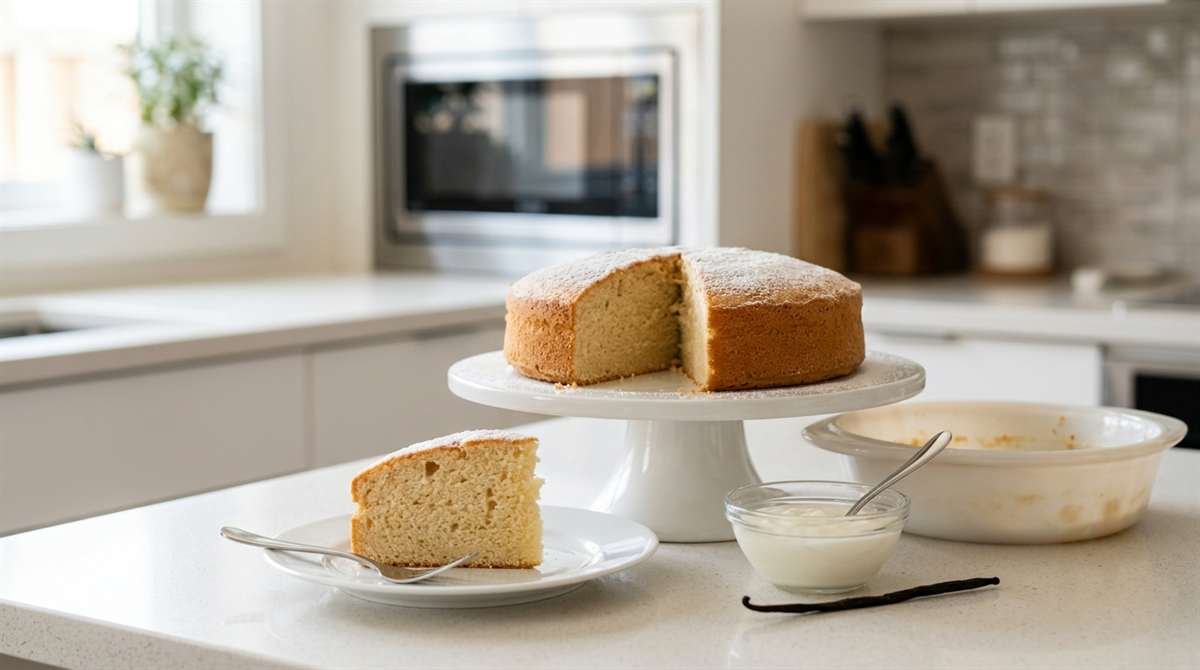
A whole cake in about 5 minutes, without eggs and without an oven, sounds too good to be true. But an eggless vanilla sponge cake in the microwave really works, as long as you understand one thing: microwaves cook cake very fast, and a few extra seconds can turn soft cake into rubber.
This recipe uses yogurt (curd), baking powder and baking soda to make the cake rise instead of eggs. You'll get a light, soft, vanilla cake that's perfect plain, with a little jam, or as a base for a simple birthday cake.
Recipe at a Glance
- Prep time: 10 minutes
- Cook time: 4–6 minutes (depends on your microwave)
- Rest time: 5 minutes in the microwave, then 15 minutes to cool
- Total time: about 35 minutes
- Yield: one 6-inch round cake (6 slices)
- Difficulty: Easy
- Diet: Eggless, vegetarian
How Does a Cake Rise Without Eggs?
In a normal cake, eggs help it rise and hold it together. Here, two things do that job:
- Yogurt + baking soda. Yogurt is a little sour. When baking soda meets something sour, it makes tiny bubbles of gas. These bubbles make the cake light and airy.
- Baking powder. It makes more bubbles when the batter gets hot, so the cake keeps rising while it cooks.
Yogurt also keeps the cake moist and soft.
Ingredients
- 1 cup (125 g) all-purpose flour (maida)
- 1 teaspoon baking powder
- ¼ teaspoon baking soda
- A pinch of salt
- ½ cup (120 g) plain yogurt (curd), at room temperature
- ½ cup (100 g) granulated sugar (or powdered sugar for a smoother batter)
- ¼ cup (60 ml) neutral oil or melted butter
- ¼ cup (60 ml) milk, at room temperature (add 1–2 tablespoons more if needed)
- 1 teaspoon vanilla extract
How to measure flour correctly: Spoon the flour into the cup and level it with a knife. Don't scoop the cup straight into the bag, because that packs in too much flour and makes the cake dry. If you have a kitchen scale, use 125 g.
Equipment
- A microwave-safe round dish, about 6 inches (15 cm) wide and at least 2½ inches (6 cm) deep. Glass or silicone works well. Never use a metal pan in the microwave.
- Parchment (baking) paper
- 2 mixing bowls and a whisk
- A toothpick or thin skewer
A deep dish is important. The batter rises a lot, so the dish should be filled only about halfway.
How to Make It
-
Get the dish ready. Lightly grease the dish with oil. Cut a circle of parchment paper and place it on the bottom. This helps the cake come out easily.
-
Mix the wet ingredients. In a large bowl, whisk the yogurt and sugar for 1–2 minutes until the sugar mostly dissolves. Add the oil, milk and vanilla. Whisk until smooth.
-
Mix the dry ingredients. In another bowl, stir together the flour, baking powder, baking soda and salt. If you have a sieve, sift them. This removes lumps and adds air.
-
Combine gently. Add the dry mix to the wet mix in two parts. Use a spatula or whisk and mix only until no dry flour is left. A few small lumps are fine. Mixing too much makes the cake tough.
-
Check the batter. It should be thick but pourable, and fall slowly off the spoon in ribbons. If it's too thick to pour, add milk 1 tablespoon at a time.
-
Pour and tap. Pour the batter into the dish. Tap the dish gently on the counter 2–3 times to pop big air bubbles.
-
Microwave. Place the dish in the center of the microwave. Cook on high (100% power). For a 1000-watt microwave, start with 4 minutes. See the timing guide below for other microwaves.
-
Test it. Insert a toothpick in the center. If it comes out clean or with a few dry crumbs, it's done. If you see wet batter, cook for 15–20 more seconds and test again.
-
Rest. Leave the cake inside the closed microwave for 5 minutes. It keeps cooking a little from its own heat. The top may look slightly wet when you take it out, but it will set as it rests.
-
Cool and remove. Run a knife around the edge, turn it out onto a plate, and peel off the paper. Let it cool for at least 15 minutes before slicing.
Microwave Timing Guide
Microwaves have different power levels, measured in watts. You can usually find this on a sticker inside the door or in the manual.
| Microwave power | Starting time on high |
|---|---|
| 700–800 watts | 5–6 minutes |
| 900–1000 watts | 4–5 minutes |
| 1100–1200 watts | 3½–4 minutes |
Always start with the shorter time. You can add more time, but you can't fix an overcooked cake. If your microwave has no turntable, turn the dish halfway through.
Tips for a Soft, Fluffy Cake
- Use room-temperature yogurt and milk. Cold ingredients make a thick batter that doesn't rise as well.
- Don't overmix. Stop stirring as soon as the flour disappears.
- Use fresh baking powder and baking soda. Old ones lose power. To test baking soda, drop a pinch into vinegar. If it fizzes, it's good.
- Don't open the door too often. Every time you open it, the cake loses heat and steam.
- Cover after cooling. Microwave cakes dry out faster than oven cakes. Once cool, keep it covered.
Common Problems and Fixes
The cake is rubbery and chewy.
It was cooked too long, or the batter was mixed too much. Cut the time by 30–60 seconds next time and mix gently.
The middle is wet and sticky.
It needed more time. Cook in 15-second steps until the toothpick comes out clean. A very thick dish can also cause this.
The cake didn't rise.
The baking powder or soda may be old, or the batter sat too long before cooking. Put the cake in the microwave right after mixing.
The cake is dry.
It was overcooked, or too much flour was used. Measure flour carefully and use the shorter cooking time.
The cake rose and then sank.
The middle wasn't fully cooked. Add 15–20 seconds next time and always do the toothpick test.
The cake overflowed.
The dish was too small or too shallow. Use a dish that's filled only halfway with batter.
Easy Variations
- Chocolate cake: Replace 3 tablespoons of flour with 3 tablespoons of unsweetened cocoa powder, and add 1 extra tablespoon of milk.
- Lemon cake: Add 1 teaspoon lemon zest and replace 1 tablespoon of milk with lemon juice.
- Tutti frutti cake: Toss 3 tablespoons of tutti frutti (candied fruit) in a little flour and fold it into the batter.
- Mug cakes: Divide the batter into 3–4 large mugs, filling each only halfway. Cook one mug at a time for about 1 minute to 1 minute 30 seconds, checking at 1 minute.
- Butter cake: Use melted butter instead of oil for a richer taste. Oil gives a softer, moister cake.
Simple Ways to Serve It
- Dust the top with powdered sugar.
- Spread a thin layer of jam and cover with whipped cream.
- Slice it in half across the middle, fill with whipped cream and fresh fruit, and make a small layer cake.
- Serve warm with a scoop of vanilla ice cream.
- Pour a little melted chocolate over the top.
Looking for more quick ideas? Browse all our recipes.
Storage and Freezing
Room temperature: Keep the cooled cake in an airtight container for up to 2 days. If it has a cream or fruit filling, keep it in the fridge instead.
Fridge: Plain cake lasts up to 4–5 days in an airtight container. It gets firmer in the fridge, so let it sit out for 15 minutes or warm a slice for 8–10 seconds before eating.
Freezer: The plain cake (without cream) freezes well. Wrap it tightly in plastic wrap and then foil, or freeze single slices. Freeze for up to 2 months. Thaw at room temperature for about 1 hour.
Reheating: Warm a slice in the microwave for only 8–10 seconds. Any longer and it can turn hard.
Nutrition Estimate
Per slice (1/6 of the cake), made with oil and whole-milk yogurt:
- Calories: about 245
- Carbohydrates: about 37 g
- Sugar: about 18 g
- Fat: about 10 g
- Protein: about 4 g
Butter instead of oil, extra frosting, or larger slices will change these numbers.
Eggless Vanilla Sponge Cake in Microwave
A soft, fluffy eggless vanilla cake made in the microwave in minutes.
Rest and cool time: 20 minutes
Power: High (100%); about 4 minutes in a 1000-watt microwave
Ingredients
Instructions
- Step 1Grease a 6-inch microwave-safe dish (at least 2½ inches deep) and line the bottom with parchment paper.
- Step 2Whisk yogurt and sugar for 1–2 minutes. Add oil, milk and vanilla and whisk smooth.
- Step 3In another bowl, mix flour, baking powder, baking soda and salt.
- Step 4Fold dry ingredients into wet ingredients just until no dry flour remains.
- Step 5Pour into the dish and tap gently to remove large bubbles.
- Step 6Microwave on high: about 4 minutes for 1000 watts (5–6 minutes for 700–800 watts; 3½–4 minutes for 1100–1200 watts).
- Step 7Test with a toothpick. If wet, cook 15–20 seconds more and test again.
- Step 8Rest 5 minutes in the closed microwave. Turn out, remove paper and cool 15 minutes before slicing.
Storage: Airtight at room temperature for 2 days, in the fridge for 4–5 days, or frozen (plain) for up to 2 months.
Nutrition (estimate per slice): about 245 calories, 37 g carbohydrates, 18 g sugar, 10 g fat, 4 g protein.
Frequently Asked Questions
Can I use the convection mode instead?
Yes, but then it's baking, not microwaving. In convection mode, use a metal or glass pan and bake at 350°F (180°C) for about 25–30 minutes. The microwave times in this recipe are only for regular microwave mode.
Why is my microwave cake rubbery?
It was cooked too long. Microwave cakes overcook very quickly. Start with less time and use the toothpick test.
Can I use whole wheat flour?
You can replace up to half of the flour with whole wheat flour (atta). The cake will be denser and a little darker. Add 1 extra tablespoon of milk.
Can I make it without yogurt?
Yes. Mix ½ cup milk with 1½ teaspoons lemon juice or vinegar and let it sit for 5 minutes. Use this instead of the yogurt, and skip the ¼ cup of milk.
What size dish should I use?
A 6-inch (15 cm) round dish that's at least 2½ inches deep. A wider dish makes a thinner cake that cooks faster, so check it 30–60 seconds early.
Can I frost this cake?
Yes. Let it cool completely first, or the frosting will melt. Whipped cream, buttercream or chocolate ganache all work well.
More Recipes to Try
- 30+ Easy Air Fryer Snacks Without Cheese
- Best Easy Banana Bread, Moist (coming soon)
- Best Chewy Chocolate Chip Cookies, No Chill (coming soon)
- Homemade Caramel Sauce Without Heavy Cream (coming soon)
- Browse all recipes
A Final Note
The most important part of this recipe is not the ingredients. It's the timing. Once you find the exact number of minutes for your microwave, write it on a sticky note on the microwave. After that, a soft homemade cake is only a few minutes away whenever you want one.